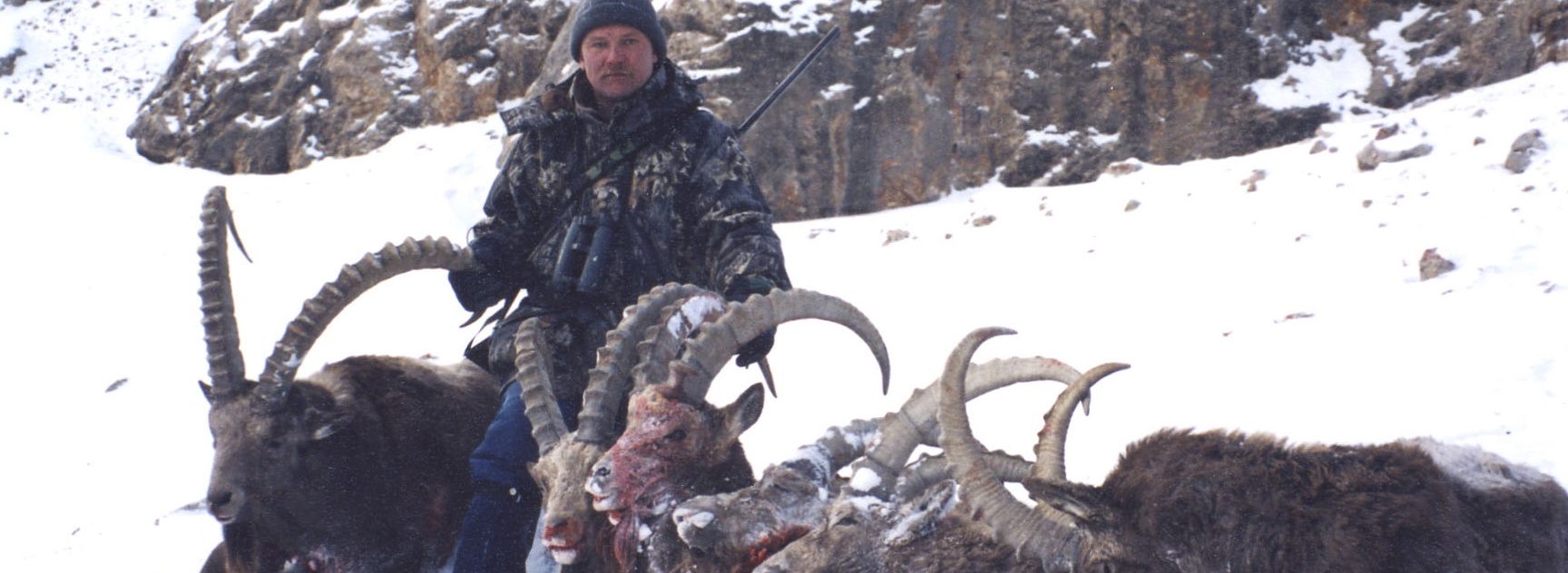

Hunting ibex (capra sibirica) in Asia is a challenging experience. The parts of the world where Asian ibex is found are incredibly remote; the mountains are treacherous, and elevations are often formidable. Ibex naturally takes high ground to watch for wolves; the best trophies are sometimes found at elevations over 14,000 feet. In winter, when ibex descends to lower elevations, the temperature can plummet to -30 C, and deep snow makes traveling hard. However, this hunt is rewarded by seeing the stunningly beautiful countryside and seeing spectacular animals. Nine out of 13 subspecies and races of Asian ibex inhabit Russia and Central Asian countries – Kazakhstan, Kyrgyzstan, and Tajikistan. Sergei Shushunov offers ibex hunts for three species and subspecies of Asian ibex: Siberian, also called Altai ibex, Mid-Asian ibex, also called Tyan Shan ibex, and Pamir ibex in Russia, Kyrgyzstan, Kazakhstan, and Tajikistan. The animal known as “bezoar ibex” is nominally not classified as ibex; therefore, it is not discussed on this website.
SIBERIAN IBEX
Capra sibirica sibirica
(Ibice Siberiano, Sibirischer Steinbock, Bouquetin de Siberie)
DESCRIPTION & TAXONOMY
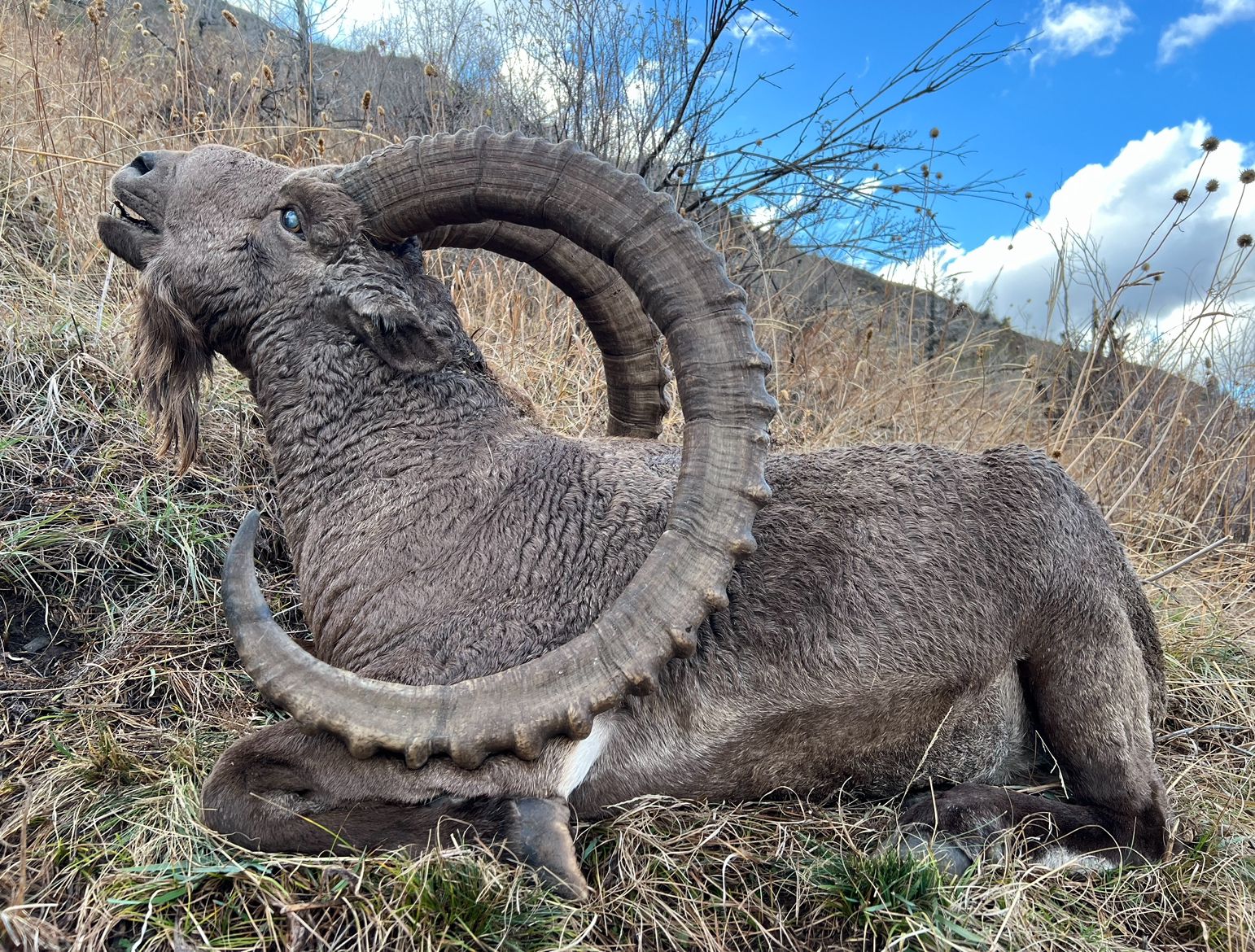
This ibex has thick legs, a stocky body, a long, pointed chin beard, and thick, heavily curved horns, often reaching 110 cm. The summer coat is short. In winter, the coat becomes long, coarse, and brittle. The winter undercoat is thick. The color is variable, but generally, in summer, it is a shade of yellowish or grayish-brown with a darker back stripe, dark underparts and legs, and without a lighter saddle patch. The winter coat is yellowish-white, and usually, there is a large, light saddle patch. The back stripe, tail, and beard in winter are dark brown. Males have thick, long, and impressive horns, which curve backward, forming half to three-quarters of a circle. Horns taper gradually to form slender points. Horns are more or less flat on the front surface and have massive cross ridges. Races include altaica (Irtish Altai), fasciata (northeast Altai), Iydekkeri (Katutay Range of Altai), sibirica (Sayan Mountains west of Lake Baikal), and typica (Tunkinskie Belki east of Irkutsk)
DISTRIBUTION
Sayan and Altai mountains of Siberia, Kazakhstan, and Mongolia.
HUNT
Siberian, or Altai ibex, prefers open, precipitous terrain at moderate elevations. We organize hunting for the Siberian Ibex in the Altai and Sayan Mountains of Russia, which are very close to the Mongolian border. The altitude of the hunt is around 1500-2500 meters (4500 – 8000 ft.). The hunter should be in decent physical shape. The ability to ride a horse is essential. The hunter has to bring binoculars, a range finder, comfortable mountain boots, a windproof camouflage jacket, warm clothes, sunglasses, sunscreen, and a sleeping bag. The tour is 11 days from Barnaul. The usual trophy size is 100-110 cm. A flat shooting cartridge similar to a 7 mm magnum caliber is the best.
SASON
August 15-Movember 30
MID ASIAN IBEX
Capra sibirica alaiana
(Tian Shan ibex)
DESCRIPTION & TAXONOMY
This subspecies of Asian ibex is the largest with the longest horns. Mature males usually weigh around 220 lbs (100 kg) and can exceed 280 lbs (130 kg). The coat color is very different from that of the Siberian ibex. In winter, most adult males have a coat of cinnamon color of varying intensity, with darker and duller tones on the flanks, shoulders, and thighs. There is usually a dark, well-developed stripe along the spine and a light-colored saddle patch that can vary in size, shape, and location. A very dark flank band separates the brown flanks from the whitish belly. There is a distinct brown band on the front surface of the forelegs and a lighter one on the hind legs. The head is lighter than the flanks-actually somewhat grayish-and the beard is brown. Mid Asian ibex includes the following races: alaiana, almasyi, merzbacheri, and transalaiana. Ibex from Tajikistan (alaiana race, or Pamir ibex) have been described as light grayish-brown in summer, with a dark dorsal stripe but no saddle patch, and bright foxy red in winter, with a distinct light saddle patch. Those from the Terskey-Ala-Too range in Kyrgyzstan (almasyi race) can be reddish-brown-fawn in summer, with distinct light saddle and neck patches and tending to gray on the head, turning to some shade of grayish-brown in winter, with a broad dark back stripe and small, dark saddle and neck patches. The horns are long and relatively slender, with comparatively small cross ridges. Ibexes of the Naryn district in Kirghizstan (merzbacheri race) are somewhat different from almasyi, having lighter coloration, a more distinctly defined dorsal saddle, and much shorter, more divergent, and more heavily knotted horns. The SCI record trophy was taken in Kyrgyzstan and had the left horn at 151.4 cm (59 5/8″) and the right horn at 152.7 cm (60 1/8″). There are unofficial reports of much larger trophies exceeding 160 cm
DISTRIBUTION
The Pamir, Altai, and Tian Shan mountains in Afghanistan, Tajikistan, Kyrgyzstan, Kazakhstan, and China.
HUNT
We offer Mid-Asian Ibex hunting in Kyrgyzstan and Tajikistan. The hunter has to be in good physical condition and be prepared to face a high-altitude environment. Horse riding skills are essential, especially in Kyrgyzstan. The hunt takes place at 2,500-4,500 meters (8,000-14,800 ft.). The duration of the tour is usually 10 days. The hunter must bring binoculars, a range finder, comfortable mountain boots, a windproof camouflage jacket, warm clothes, sunglasses, sunscreen, and a sleeping bag. Accommodations are in well-equipped cabins. It may be required to spend a night or two in the field. The best trophies usually come from Kyrgyzstan, where, in some areas, animals with horns up to 130-135 cm (52-54″) are not uncommon. However, the usual trophy size is 110-120 cm. Hunting in Kazakhstan, taking place at lower elevations, is less physically challenging. Shots are frequently taken at 300-500 yards. A flat shooting cartridge in 7 mm Remington magnum range caliber is recommended.
SEASONS
August 15 – December 15
January 15 – March 1
Please visit our trophy gallery
Visit the Russian Hunting Agency site for more information on ibex hunting.
Email sergei@russianhunting.com.
Telephone/WhatsApp: +1 (847) 962-1858